Friday, 11 May 2018

Mauritius - Our Island Holiday

“A volcanic island of palm-fringed white sandy beaches and lagoons that are protected from the open sea by the world’s third largest coral reef that surround most of the coastline”
Mauritius -has just two seasons: a warm, humid summer from November to April and a relatively cool dry winter from June to September.
We were fortunate to spend a week in ‘Beautiful Tropical Mauritius’.  We stayed in 'Pointe aux Piments', an area on the Northern side of Mauritius.  We got to see and experience most of Mauritius via a four day tour with a tourist company and our own travelling with local transport, which proved to be an interesting one.


"Church in the Park"
How beautiful is this... a church at the seaside under the trees...

Pointe aux Piments


Touring The North side was very interesting, with vast Panoramic views of Port Louis and its harbor from the Citadel Fort.  Port Louis is the capital and largest city in Mauritius. 
It is a member of the Commonwealth of Nations and the African Union. Port Louis is the country's economic, cultural and political center, and most populous city.   Expansion of the tourism industry in the late 1990's led to considerable development in Port Louis, with many shops, hotels, and restaurants being built in the Caudan Waterfront area.
The city is full of numerous buildings and monuments that reflect its rich and diverse colonial history. Near the city center, there are several French colonial buildings that date to the 18th century, including Government House. Other prominent traditional elements include the Jummah Mosque, the majestic English Saint James Cathedral, the Indian Tamil Temple, the elegant five-tier colonial Port Louis Theater, the Champ de Mars Racecourse, and the nearby Chinese Pagoda. –Wikipedia

Grand Bay/Baie which is located on the northwest coast of Mauritius is really beautiful with its white-sand beaches, glass-bottom boat trips that provide a window on the underwater world, snorkeling which was one of the most magical experiences for me in Mauritius.  Crafts shops, touristy shops and stalls, craft markets, shopping mall etc.


L'ILE Aux Cerfs
If you wanting to go ‘Under sea walking, parasailing, tube riding’ etc. then this would be the place for you.  We also got to travel in a high speed boat on a huge river to a take in the view of a beautiful waterfall and then to L‘Ile Aux Cerfs Island’, where we had lunch on the private owned island.  
Caught in a Cyclone
Mauritius does experience seasonal cyclones.  So of course we were caught in one (cyclone) whilst on the boat on our return trip from L’ile Aux Cerfs Island.  We were hit by this gushing storm (“Cyclone” we were told after we got off the boat), that rocked our boat around wildly over the rough sea... with no vision of any land any where around us.  We were drenched and so were everything else on the boat.  It kind of reminded me of the movie, “Life of Pi”…  Oh my Gosh!!! An experience never to forget that lasted for about 20 minutes, but felt like much longer though.

On the South Side we got to visit the ship model factory shop and other souvenir shops.

As well as ‘Volcano crater Bassin’ an extinct volcano from which we had a beautiful panoramic view of Curepipe and its beautiful mountain range. 

At Grand Bassin we visited the holy lake of the Hindu faith as well as the 108 feet statue of Mangal Mahadev and the statue of the Goddess Durga.


Valley of 23 Colour Nature Park
This magnificent amphitheater valley offers instant inspiration to nature lover – the colored earth and indigenous flora and fauna, views of a range of natural landscape comprising of plateaus, mountains, valleys, craters, a volcano skyline, ponds and waterfalls. 
They also have other activities like quad biking, zip-lines, 350 meters Nepalese Bridge walk etc. at European prices of course.


It’s People & Language
The people of Mauritius are multi-ethnic, multi-religious, multicultural and multilingual. 
Mauritius has a population of about 1.3 million according to the 2011 census made by ‘Statistics Mauritius’.  Hinduism is the largest religion in Mauritius, representing approximately 51.9%, followed by Christianity, Islam, Buddhism, Chinese and other. Creoles (of African descent or mixed-race) are about a quarter of the population. 

Mauritian Creole is spoken by an estimated 90% of the population and is considered to be the native language of the country, although the Mauritian Constitution makes no mention of an official language. Thus the citizens of Mauritius speak English, French, Mauritian Creole, French-based Creole, and ethnic languages such as Hindi, Telugu, Tamil, Urdu, Malayalam, Marathi, or Mandarin.

Some Geography
Did you know that Mauritius is ranked second in an ‘air quality index’ released by the World Health Organization in 2011, just goes to show, being on holiday in Mauritius can be good for your health – firstly, a wonderful opportunity to avoid the traffic fumes back home and secondly, fun in the sun and of course its beautiful white-sand beaches.
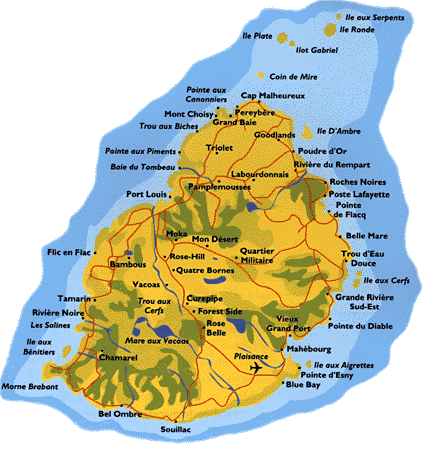
Mauritius was created by volcanic activity some 8 million years ago. Together with ‘Saint Brandon, RĂ©union, and Rodrigues’, the island is part of the ‘Mascarene Islands’. These islands have emerged as a result of gigantic underwater volcanic eruptions that happened thousands of kilometres to the east of the continental block made up of Africa and Madagascar.
The island is situated approximately 2400 kilometres off the South East Coast of Africa. The island covers an area of 1,865 square kilometres or 720 square miles, with 330 kilometres of coastline. Mauritius is 65km in length and 45km in width.

Some History
Formerly a Dutch colony (1638–1710) and a French colony (1715–1810), Mauritius became a British colonial possession in 1810 and remained so until 1968, the year in which it attained independence.  It became a republic in 1992.

Dodo Bird
This blog won’t be complete if I left out the ‘Dodo bird’.  The island is widely known as the only known home of the extinct flightless dodo bird - family of pigeons and doves. The Dodo was made extinct by human activities shortly after the island's earlier occupants.  The closest living relative of the dodo is the Nicobar pigeon which can be found in its typical forest habitat on isolated Southeast Asian islands.

Pyramids
Well before leaving for Mauritius I did a bit of ‘googling’ on Mauritius and came across an article about the Pyramids in Mauritius, and of course who wouldn’t be intrigued.  Fortunately the tour guide agreed to show it to us via a super short stop.  We took some photos…from a distance though, actually from the freeway across the road.  Unfortunately, the viewing of the Pyramids is not part of or on the list of ‘things to see in Mauritius’.  There has been some controversy about these Pyramids though; you can read more about them here: http://blog.airmauritius.com/seven-pyramids-mauritius/
Oh yes before I forget, (for the South African readers), it is very easy mistakenly feel that you are in KwaZulu Natal with the abundance of ‘sugar cane crops’ all around, between the towns.

....and the contrast!


Shopping Mall in Grand Bay!


"Fascinating Sight"
Not something we see every day (well in Durban anyway) in this age of Modern "Mobile technology"


Here's me, signing off :)Thank you!                      

Friday, 20 April 2018

India Glorious India

We recently visited India to attend a Celebration of our Divine Mother and Teacher, H.H. Shri Mataji Nirmala Devi.  The first leg of our journey was a pilgrimage and an unforgettable divine experience indeed. 

But, today’s blog is not so much about the above but more about our travels through a very small...teeny weeny part of India.  It is with love and the greatest respect I humbly share some of our experiences with you.

 An amazing country for sure!

“It is the seventh-largest country by area, the second-most populous country (with over 1.2 billion
people), and the most populous democracy in the world. It is bounded by the Indian Ocean on the south, the Arabian Sea on the southwest, and the Bay of Bengal on the southeast. It shares land borders with Pakistan to the west; China, Nepal, and Bhutan to the northeast; and Myanmar and Bangladesh to the east. In the Indian Ocean, India is in the vicinity of Sri Lanka and the Maldives. India's Andaman and Nicobar Islands share a maritime border with Thailand and Indonesia.” – ‘Wikipedia’

India, even with its poverty, over-population, crowded noisy jammed up streets at certain parts – it would be foolish to allow this to stand in ones way of recognizing this glorious, amazing, colorful, beautiful, deeply spiritual country.  XLMS​​
India has always been known for its richness in ‘Arts & Architecture, Literature, Performing Arts, Motion Pictures, Cuisine, Spices, Clothing, Fabric, Sports etc.  One can say that India must have been blessed by the Divine.

We've been to India many times before, however, the last time we visited was in 2006 and now we honestly say that India has changed.  Oh my gosh, India is going through physical transformation at a great speed.  Throughout our travels we noticed major construction taking place from building bigger, wider roads to more bridges and freeways to huge residential and commercial buildings.  Development and growth is taking place from all directions, be it commercial, economical, technological, environmental, physical mental emotional wellness and spiritual growth.  We are so grateful to have been given this opportunity to visit once again.
​​SML​​


Our Arrival
We landed at Mumbai’s 'Shivaji Chhatrapati International Airport' and from there we weaved our way through a very small section of India. 

MUMBAI
We spent our first night in Mumbai –previously known and Bombay, situated on the west coast of India, the capital city of Maharashtra and one to the world’s largest and densely populated city with an estimated population of 12.4 million as of 2011.  Mumbai is the financial, commercial and entertainment capital of India.


NARGOL
The next day we taxied our way from Mumbai, to Nargol.  We spent one night here.  Nargol is a village located in the southern region of the Indian state of Gujarat near the Maharashtra border. It lies about 150 kilometers north from Mumbai. Nargol beach is dotted with Casuarina trees and the waters have a population of sea turtles.  Nargol is a small typical ‘Indian style village’ surrounded with small farmhouse type of dwelling. The beaches are wide and lonely sand-beaches with big tidal water level differences.
​​SML
We visited Nargol because it is of great importance to us, the followers of Sahaja Yoga. One of the Casuarina tree (or Saru tree) is called "Nirmal Tree".  The founder and spiritual leader of Sahaja Yoga, Shri Mataji Nirmala Devi, opened the Sahasrara chakra in Nargol in the year 1970 under that tree, thus marking the beginning of Sahaja Yoga. Meditating in this space was really amazingly beautiful - in a meditative state continuously.

The forest land surrounding "Nirmal Tree" has been declared and inaugurated as "Nirmal Van" ("Pure Forest") in an official ceremony on 2 March 2009 by representatives of the Indian government and other state authorities. The Forest Department protects it as Eco - Zone under, JFMC (South Valsad Forest Division of Gujarat State) for promotion of environmental awareness, ecotourism and peace project.

Nargol is also known for its Parsi (Zoroastrian) population as the Persians (Zoroastrians) migrated from Persia to land on the shores of Nargol first then spread south to Sanjan and north to Udvada.

PUNE
The next day we continued on to Pune from Nargol, about a 6 hour drive by taxi.
Pune is the second largest city in the Indian state of Maharashtra after Mumbai and the seventh most populous city in the country. It considered to be the cultural capital of Maharashtra. Pune is known as "Oxford of the East" due to the presence of several well-known educational institutions in the city. Pune is one of the fastest growing cities in the Asia-Pacific region.  Pune is also wonderful for shopping, well we did some shopping here, eastern wear of course. 
Whilst in Pune, we were fortunate to be able to visit my cousin. It was really wonderful meeting with her after so many years. We had an opportunity to catch up and enjoy a very scrumptious lunch together…yum yum!!!

PRATISHTHAN Sahaja Yoga, in Pune is an Ashram and Museum for Sahaja Yogis.
​​SMLHer Holiness Shri Mataji Nirmala Devi lived in Pratishthan from 1986 till 2010. Her residence ‘Pratishthan’ was named after the capital of her ancestors the Shalivahana (presently called Paithan).  Shri Mataji personally designed Pratishthan to demonstrate how vibrations penetrate matter and create the coefficient of vibrations.  As a result Sahaja yogis come here to enjoy the beautiful vibrations that take one into deep thoughtless meditation that is a spontaneous happening. Our three night stay here was truly magical and deeply spiritual experience.​​

NAGPUR
We then took a flight to Nagpur.  We had to say good bye, to a wonderful taxi driver, Vincent, who looked after us as a brother would take care of his sisters.

Nagpur is the third-largest city of the Indian state of Maharashtra after Mumbai and Pune. Nagpur is the 13th largest Indian city in terms of population. It has been proposed as one of the Smart Cities in Maharashtra.

Oh and here is the bit/trip never to forget - Our taxi drive from Nagpur airport to Chhindwara. 
All four of us (ladies) were tightly packed, like sardines in a can, into a very small car - Fiat Pinto, with four and a half suit cases plus four back packs and some hand bags.  This journey, a long hilarious one, lasted about 3 hours. This situation came about by the arranged taxi man that sent his friend to pick us up but forgot to mention that we were more than one passenger.


CHHINDWARA
Our three night stay at ‘Hotel The Karan’, was wonderful, highly recommended. The service was excellent the food was delicious and the stay was comfortable.

The main reason for our trip to India was to attend the Birthday celebration of the founder of Sahaja Yoga, H H Shri Mataji Nirmala Devi, in Chhindwara.  It was a purely divine experience I which I wish I could share with the world.


“Thousands of followers of Sahaja Yoga come every year to Chhindwara to visit the birthplace of H.H. Shri Mataji Nirmala Devi, founder of Sahaja Yoga. She was born on March 21, 1923 to a Christian family in Chhindwara, India (http://www.chhindwara.org). Her parents were Prasad Salve and Cornelia Salve, direct descendants of the royal Shalivahana dynasty. Seeing the beauty of this child who was born with a spotless brilliance, they called her Nirmala, which means 'Immaculate'. Later on, she came to be known by the multitudes by the name of H.H. Shri Mataji Nirmala Devi — the revered Mother — who was born with her complete Self Realization and knew from a very young age that she had a unique gift which had to be made available to all mankind. Her parents played a key role in India's Liberation Movement from under British rule. Her father, a close associate of Mahatma Gandhi, was a member of the Constituent Assembly of India and helped write free India's first constitution. He was a renowned scholar, master of 14 languages, and translated the Koran into Marathi. Her mother was the first woman in India to receive an Honors Degree in Mathematics. “Wikipedia”

“Chhindwara is the most rapidly developing city in Madhya Pradesh. It was believed that Chhindwara District was full of "Chhind" (date palm or khajoor) trees many years ago, and the place was named "Chhind"-"Wada" (wada means place). There is another story that because of the population of lions (called "sinh" in Hindi), it was considered that making entry into this district is akin to entering the lions' den. Hence it was called "Sinh Dwara" (means through the entrance of lion). In due course it became "Chhindwara". Wikipedia”

MUMBAI – Shoppers paradise
​​SMLOn the 22nd evening we took a flight back to Mumbai were we spent our last three nights of our journey, experiencing the very busy, noisy, crowded Mumbai. Mumbai is known for its shopping and that’s exactly what we did, oh and eat :).  We stayed in Colaba, close to all the shopping bargains…and of course we bargained our way through quite a few different stores.  We also did a few touristy things like visiting (the outside) of a few Indian Movie star homes, Shopping malls, Beaches etc.
25th March, we left India for home after a two weeks stay.:)
​​
SML


IN CONCLUSION
One of the most memorable part of the trip was the people.  I am very grateful to have crossed paths or came in contact with all these beautiful people along the way.  Be it the Auto rickshaw driver, taxi drivers, doorman, reception man, travel agency, shop owners/ assistants and especially the Sahaja Yogis from around the world.  This in itself was a wonderful blessing.  It was really comforting and joyous to be shown so much of love and care by those you have never met before. So in a nut shell....we had a wonderful, enjoyable, amazing time but most importantly a deeply spiritual one.
 SML

Should you wish to know more about Sahaja Yoga Meditation
please visit: www.sahajayogameditation.online